
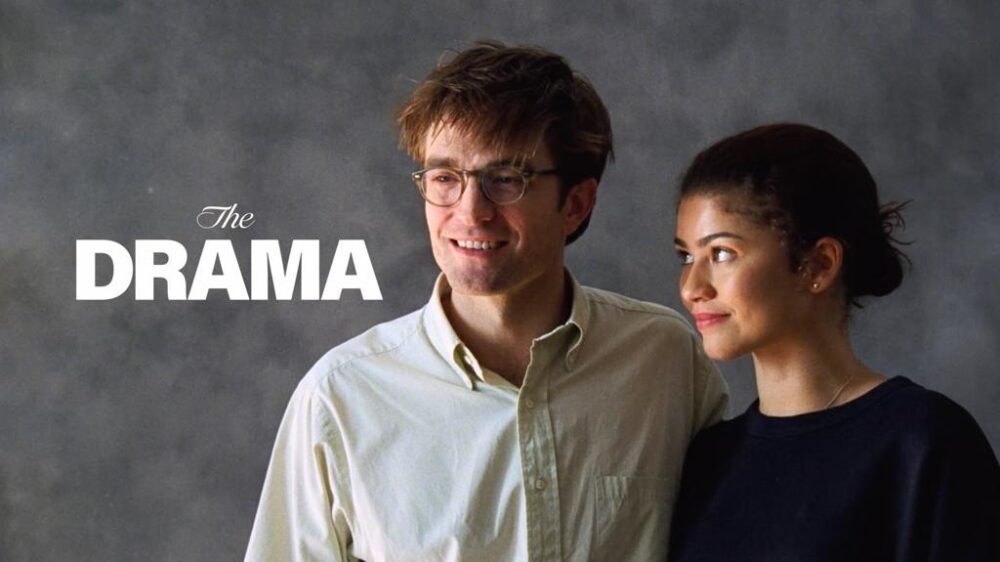
The Drama Dir: Krisoffer Borgli (13th Floor Film Review)
Someone once said to me that if you don’t want anyone to know something about you, don’t tell anyone. The Drama takes that idea and quietly pulls it apart, asking instead: how well does anyone really know another person?
Starring Zendaya, Robert Pattinson, Mamoudou Athie, Alana Haim, Hailey Gates, and Zoë Winters
Directed by Kristoffer Borgli, following his previous films Sick of Myself and Dream Scenario, the drama in The Drama begins with a deceptively simple setup.
Bride- and groom-to-be Emma (Zendaya) and Charlie (Robert Pattinson), along with their best man Mike (Mamoudou Athie) and maid of honour Rachel (Alana Haim), gather for a drunken pre-wedding dinner that turns into a four-way confessional after Rachel advises the couple that the best thing they can do before getting married is to clear the air of any potential gotchas by asking one another: “what’s the worst thing you’ve ever done?”
The potential for this to spiral into something far more consequential is—or ought to be—self-evident. Unless you can confidently claim that your darkest moral transgression is stealing a Kit-Kat (IYKYK) from the corner store at age ten, you are immediately in dangerous territory.
And when Emma, fuelled by peer pressure and a steady flow of rosé, reveals a long-buried secret that is, by any standard, very bad indeed, the cat is well and truly among the pigeons.
Leaning into the moral ambiguity that runs throughout the film, Rachel has already shared a story that may in fact be worse than Emma’s—because it involves an act of cruelty that was committed rather than merely contemplated.
However, the weight of moral judgement appears to bypass Rachel and land squarely on Emma’s shoulders, and the fallout raises an uncomfortable question: is planning to do something terrible as bad as actually doing it?
Emma never followed through with her plan, but the reasoning behind that decision is far from reassuring. It’s implied that she abandons it not out of conscience, but because someone else carried out a similar act first, thereby making her restraint appear less like morality and more like petulant frustration at being pipped at the post.
Borgli seems uninterested in drawing clear lines between right and wrong, instead leaving the audience to wrestle with degrees of discomfort.
Emma’s confession also forces a reassessment of her relationship with Charlie. Pattinson downplays his usual charisma, presenting Charlie as awkward, slightly gawky, and faintly unsettling. Even their first meeting carries a manipulative edge that could be read as more stalker-like than romantic, depending on your perspective.
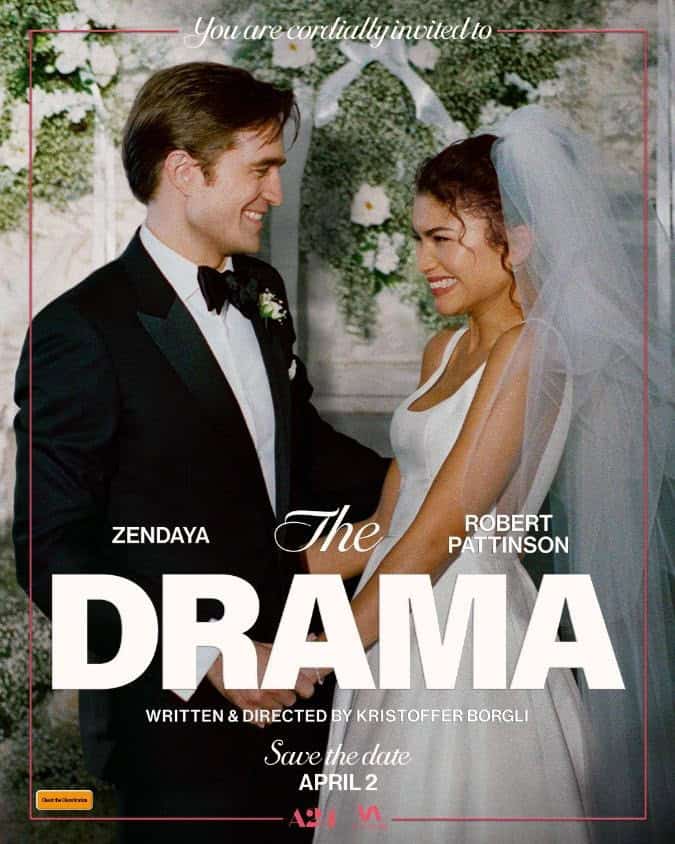
Their relationship progresses through a familiar montage into an elaborate wedding build-up—complete with a drill-sergeant-like first-dance choreographer and an extravagant reception—but there’s a lingering sense that both are performing rather than fully inhabiting their lives. They seem in danger of being overwhelmed by the wedding juggernaut, and Emma’s confession may even offer Charlie a convenient way to rationalise his growing uncertainty as they follow the paint-by-numbers playbook of modern wedding planning.
This is a film where every detail matters. Emma tells Charlie at their first meeting that she’s deaf in one ear, and he never appears to question her about it. He simply accepts it as fact. It’s hard not to wonder how things might have unfolded differently if he had been more curious—if he had learned earlier that her hearing loss stemmed from a firearm accident tied to her past. The film suggests that relationships are built not just on what we share, but on what we choose not to ask.
There is a sub-plot involving the couple’s wedding DJ who may or may not have a drug habit, that serves primarily to highlight some further (ahem) cracks in Emma and Charlie’s facade.
Despite its heavy themes, The Drama leans into black comedy, with a couple of genuine laugh-out-loud moments. One of the best involves relentlessly upbeat wedding photographer Frances (Zoe Winters) enthusiastically explaining how she plans to “shoot” the guests—an innocent choice of words that lands very differently given Emma’s history.
The film’s marketing cleverly avoids revealing the full nature of Emma’s secret, but it’s enough to say it involves an isolated teenage version of herself, her father’s shotgun, and a meticulously planned act of violence that never came to pass. Borgli tells this story in flashback, walking a precarious line between black comedy and bad taste. The subject matter is always going to be polarising, and there is at least one scene where I found myself torn between “this is really funny” and “I’m not sure I should be laughing at that”.
In the end, The Drama isn’t about what Emma did or didn’t do. It’s about what it means to carry something in secret, and what happens when that secret is finally spoken aloud. It questions whether honesty is always a virtue, or whether some truths—once revealed—can destabilise the fragile structures we build our lives on.
Ultimately, Borgli raises more questions than he answers about the fragile nature of loyalty—particularly within friendships—and how quickly the terrain can shift from solidarity to judgement.
This is a clever and original piece of filmmaking, and Zendaya and Pattinson inhabit their roles well. There is a level of detachment to their performances that matches the sense that Charlie and Emma are floating just outside their own lives—until Emma’s shocking revelation pulls everything sharply into focus.
Jo Barry
The Drama opens in cinemas tomorrow. Click here for tickets and showtimes.
