
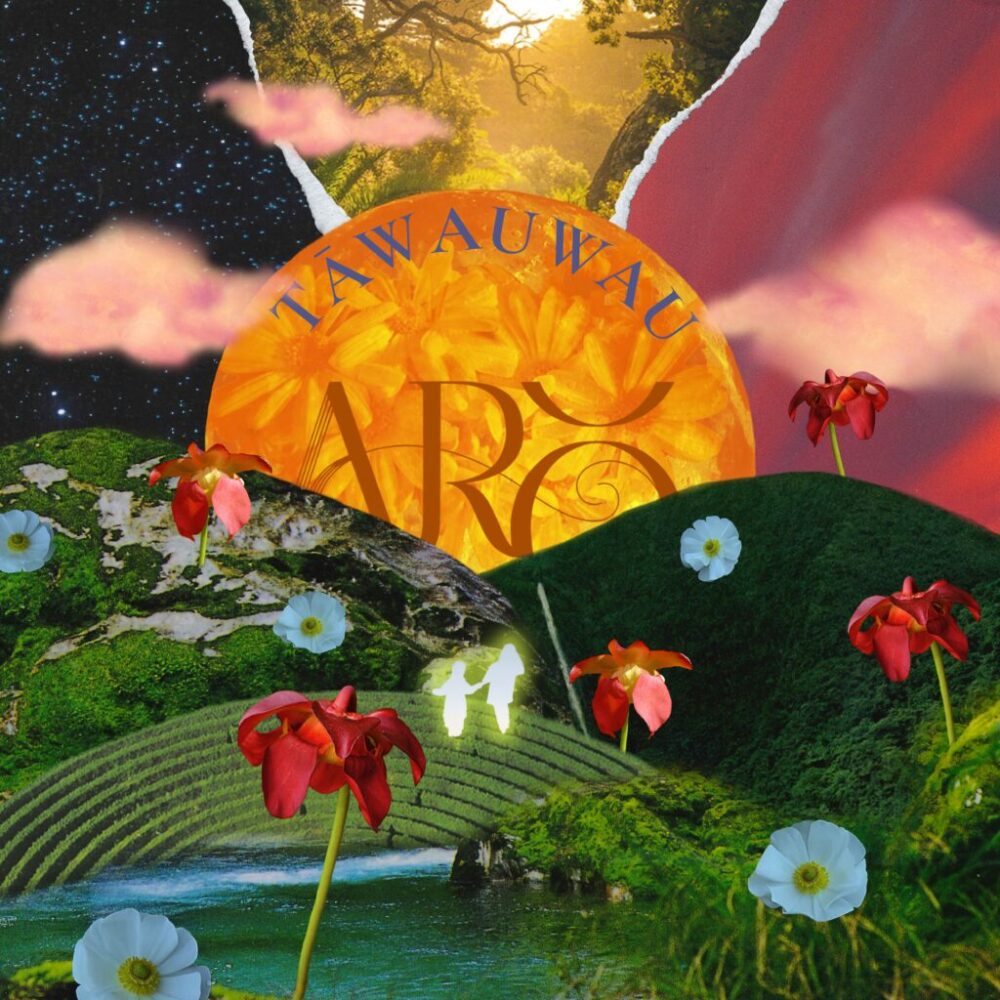
Aro – Tāwauwau (13th Floor Album Review)
Despite attempts by those at the political helm to diminish the presence of Māori language in everyday life, there’s a definte ascendency of te reo in contemporary music. Where once Moana and the Tribe were pretty much lone trailblazers singing in te reo they now have company that stretches across the spectrum of from metal (Alien Weaponry), through soul (Teeks), alt-folk (Marlon Williams) and synth-pop (Geneva AM). Aro are part of this ascendancy of songwriting that foregrounds te reo, but with a difference. That difference is partnership.
Dwelling somewhere at the confluence of folk, pop, jazz, and RnB, Aro fully embody the bicultural and bilingual foundations of Aotearoa. They are husband-and-wife duo, Emily (pakeha) and Charles (Ngāpuhi, Te Rarawa, Ngāti Te Ata Waiohua, Ngāti Mutunga) Looker whose songwriting blends te reo Māori and English and cuts through the superficial chatter of daily life to reach rich veins of the ineffable lifeblood of relationships and the land we call home.

In addition to their music, Charles and Emily are itinerant educators seeking to enlighten tamariki with knowledge of the natural world. They travel across the motu running workshops in schools and kura, blending waiata and mātauranga Māori to generate pride in identity and culture.
Tāwauwau, is Aro’s third album, a follow-up to 2019’s Manu and 2024’s He Rākau, He Ngārara. In the former they engaged with the essence of various native birds and in the latter, native trees and insects. This time, in Tāwauwau takes us somewhere deeper, described by Emily and Charles as a place beyond perception, this other ‘lighter’ world which we remember greeted us when we were kids. This statement offers a helpful framing to these songs that hint at a world only just in reach, a landscape that is both knowable but elusive.
The opening – and album title – track, Tāwauwau, pushes the album out with an evocative chant – almost a karakia, an incantation to offer welcome to the song cycle.
Next is the catchy and still-chant like Puna Ora (which translates as spring of health) featuring Emily’s lilting voice. If the opening track laid down the kaupapa of the project, this one takes us into the upwelling territory of joy, wellbeing and possibility.
The partnership that Emily and Charles embody as Pakeha and Maori is suddenly evident with Fly High which begins as a conventional English-worded electro-pop song with danceable beat but segues into a waiata replete with the rich lyricism of te reo. Its positive imperative keeps the song moving along in and out of variable beats. Mid-song, the immortal question raised by poet Mary Oliver is deftly inserted: What will you do with your one wild and precious life?
Whakataratara begins with melodic beat, its te reo and English alternating with ease. Mid-song, te ao Maori makes an entrance with a haka laying down an imperative that provides an emphatic juxtaposition with delicate singing.
Pretend is soulful and wistful, Emily’s vocals taking us into a mystical place: The deeper I go the surer I become. Lyrics that send one reaching for the pause button to listen again.
Hīraurau (which my dictionary says is to unravel or solve) is sheer beauty. I get tired of hide and seek / I don’t know how to tell you. Angst expressed with gentleness. Coffee on the stove is getting cold and I am growing old. Further lyrics in te reo. Noho. To be located …or to marry. I wish I had more reo than my courses at Waiheke Adult Learning offered. But any regret is whisked away as the song tails off with what sounds like recorder.
OYH is unpacked soon into the song as short for on your heart . A refrain of we choose to be loved. Then the surprise comes: a waiata that ends with a powerful karanga.
Burnt has that distinctive guitar strum associated with Maori songs. Emily’s fluid ease between languages again. Warm and embracing for its sound, sentiment and alternating languages of this land.

Sometimes is brief and reflective, voices layered into unison expressing as much a mood as a set of ideas.
Matangerengere unfolds atop a synth beat in a quiet questioning and ends with an almost-echo of an unaccompanied voice.
Emily sings I just want to breathe again in Tau and repeats the word manawa (heart). Another song best appreciated for the mood and its use of two languages, resisting attempts to unpack meaning.
Mystery over meaning seems to be the essence of this album. As in Mundane which chugs along with a steamtrain beat. In between the ease of te reo there are shouts of just one day that hint of Feist then swirling synths take us back to the beat and a why I’m not into you.
Last up is Stardust. Poppy, rhythmic, joyous. A perfect breezy outro for the album.
Tāwauwau is a song cycle in which the feeling is fundamental. Like a Van Morrison disc on which scat singing leaves meaning a bit opaque, so too here. Unless one is a fluent te reo speaker, much is sound rather than sense-making. But although most of us have limited dexterity in Aotearoa’s second language matters not.
As in other te reo songwriting, we can appreciate its lyrical elegance and let the words be an added instrument to take us where they will. Or, perhaps, these songs might inspire us to go more further on our te reo journey. Or maybe they just help to remind us that, despite politicians demoting the place of Aotearoa on our passports, fully-formed expressions of bilingualism will flourish regardless.
To that extent, Aro offer a vision of a future many of us will delight in.
Robin Kearns
Tāwauwau is released on all digital platforms on March 20th, 2026, with thanks to Te Māngai Pāho for supporting the making of this project.
Website | Facebook | Instagram
