
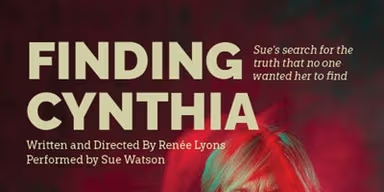
Finding Cynthia – Artworks Theatre, Waiheke Island (13th Floor Theatre Review)
You’d think a play about a woman discovering her birth identity when adoption laws were relaxed would be sternly serious stuff. Yes there’s a weighty undercurrent to this one-person performance. But there’s also an unexpected lightness to Finding Cynthia. This is thanks to the lively script and direction by Renée Lyons and compelling acting by Sue Watson.
But here’s the thing: is it acting when the actor is the persona whose story is being recounted? In this case, before a home-island audience for the premiere, it was the Sue Watson who many in attendance know narrating the turbulent journey after being contacted by her birth mother Lizzie.
The play follows the same storyline recounted at greater length in Watson’s recent book Finding Cynthia Winters (2026, Lasavia Publishing). This stage version is quick-fire in its scene changes as it charts a journey of discovery she never asked to go on.
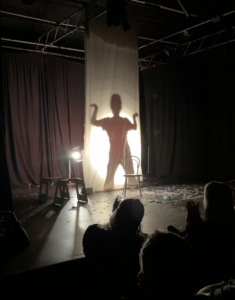
The performance opens with Watson dancing contentedly, looking splendid in striking red and black then addressing the audience: I’m Sue Watson, I get shit done. A women confident and comfortable in her own skin. But then it was the pandemic, I had a box of letters under my bed, a story to tell.
Watson, born in the early 60s unbeknownst to her as Cynthia Winters, successfully made her way in the world, supported by a loving adoptive family. Then the Adult Adoption Information Act (1985) changed everything. The law, passed to provide for greater access to information relating to adoptions allowed for contact between parties if both assented. At letter from Lizzie, Sue’s birth mother, suddenly heralded an emotional roller-coaster ride.
This is not just a personal but also a social history. Finding Cynthia illuminates some harsh realities of the ‘60s. Unmarried women were vilified for pregnancies. Adoption was the only honourable path. Her mother Lizzie, once parted from the baby Cynthia, is exiled to live in Auckland. And there’s a chilling comment that the baby market became so oversupplied that potential adoptees were graded according to desirability from brown to pink. So it was that the infant Cynthia became a chosen one.
Sue’s ambivalent relationship with her birth mother lies at the troubled heart of the performance. There is regret, longing, neediness and little warmth. But the most potent statement in the performance is All we shared was an umbilical cord and it was cut.
Dance recurs throughout as if a metaphor for the movement between life’s stages and the revelations therein. Props are few: a chair, letters that drop as if by air mail onto the stage, a large sheet behind which Watson adds drama through casting silhouettes.
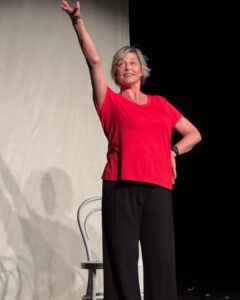
In under an hour we are carried along a journey marked by discoveries about hitherto unknown whanau. An oscillation between intrigue and self-protection follows each discovery. Information seems drip-fed and partially withheld even on the critical question of fatherhood. There’s a power dynamic at play. And all this is set alongside a talented woman’s own journey of parenthood, career and sense of place-in-the-world.
There are subtle moments that sparkle: when telling of her sojourn teaching at a University in Pennsylvania, Elton John’s Philadelphia Freedom is heard; in recounting the scene in Lampton Quay in the 1960s, Watson adopts the BBC-ish voice of a New Zealand broadcaster of the time. Her personification of bolshy maternity nurses was another of many delicious moments.
The occasional need for a subtle prompt on this, her first night before an audience didn’t detract. Rather these moments served as a reminder of the rawness of this performance by an actor newly telling her story in this captivating manner.
This is compelling theatre. It’s a story of unexpectedly finding whakapapa, dealing with familial complexity, and finding peace as one’s own person in the face of, at times, too much information. It’s a story for which there are surely many variants in Aotearoa as a generation of adoptees have learned to live with questions of who they are in light of who they might otherwise have been. And for every Cynthia there is a birth mother living with a decision which was only ever partly hers.
Robin Kearns
Finding Cynthia is performed again at Artworks Saturday 11th April, then at Bats, Wellington 16-18th April. [and hopefully in other theatres to follow]
